Structure of the system
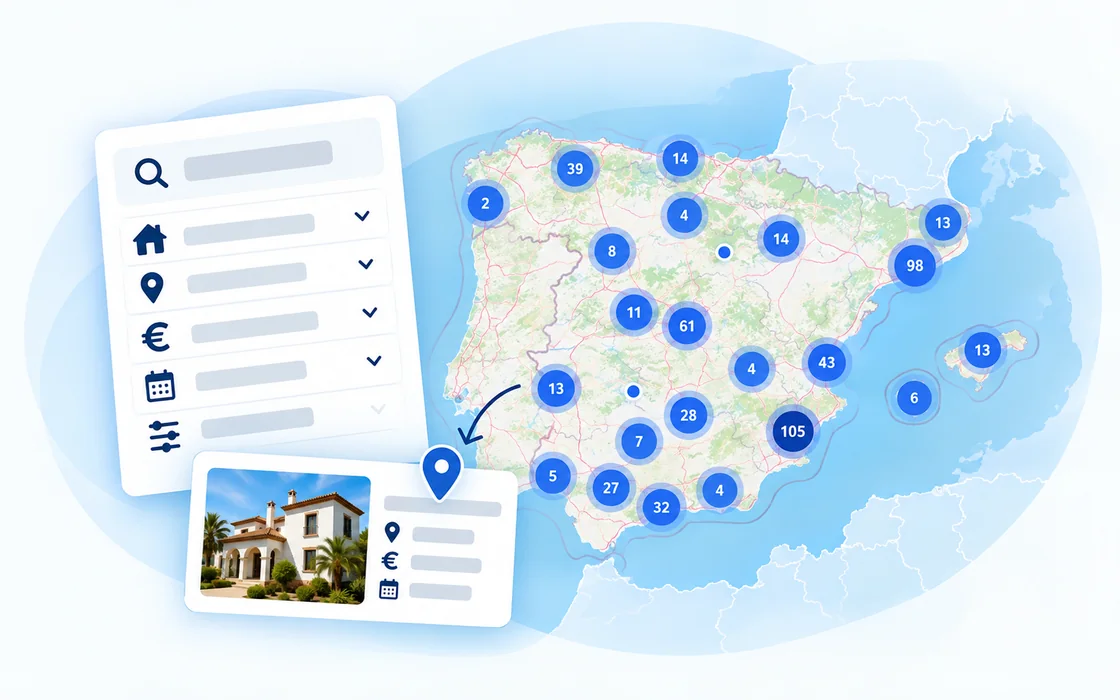
Since Ley 19/2015, virtually every public auction in Spain runs on the same technical platform.
Before 2015, every court, notary or tax authority held auctions physically, each in its own way and at its own pace. Since then, the technical process — registration, deposit payment, bidding, closing — runs through exactly the same system for every type of auction: the Portal de Subastas (subastas.boe.es), managed by the Agencia Estatal Boletín Oficial del Estado. What does differ per type is who orders the auction and under which legal regime — that is the subject of §4.
A BOE auction always originates from one of three families:
JA · JV · JC
A creditor holding an enforceable title has a seized asset sold. Court-ordered, via the Letrado de la Administración de Justicia (LAJ) — not the judge personally.
NE · NH · NV · NN
Out-of-court mortgage foreclosure, or voluntary sale via the notary. Conducted and presided over by the notary.
AT · RC · GA
Tax collection (state, region, municipality), or ordinary sale of public real estate. Ordered by the collecting authority.
This document works out the judicial route in detail — by far the largest share of supply, and the most extensively regulated by law (LEC, Ley 1/2000, amended by Ley Orgánica 1/2025, in force since 3 April 2025). §4 places the other two families alongside it.
LO 1/2025 applies to proceedings that enter the enforcement phase on or after 3 April 2025. Older proceedings run their course under the previous regime (lower deposit, longer payment term, different award percentages) — so both regimes occur side by side. The actual figure in the edicto of a specific auction always prevails over any fixed percentage in this document.

The auction, bidding and award process

Three phases: appraisal & announcement, the bidding itself, and the award — the last being where the statutory floors really come into play.
2.1 — Before the auction
Appraisal (valor de subasta): in a mortgage foreclosure, usually the amount already stated in the mortgage deed itself (art. 682 LEC); otherwise the court appoints an independent appraiser. The announcement (edicto) is published on the portal with the appraisal value, known encumbrances, occupancy status where known, and the opening date.
2.2 — The bidding process
| Aspect | Rule — judicial auction, after 3‑4‑2025 |
|---|---|
| Bidding period length | 20 calendar days from the opening date |
| Extension rule | A valid bid in the final hour automatically extends the closing by one hour |
| Access | Digital certificate / Cl@ve, plus a deposit paid in advance, via the portal |
| Deposit — real estate | 20% of the auction value, min. €1,000 was 5% |
| Deposit — movable property | 10% of the value, min. €1,000 was 5% |
| Exception | The enforcing creditor may bid without a deposit as long as no one else participates |
| Refund | Losing bidders get their deposit back; for the winner it is offset against the price |
There is no statutory minimum bid during the bidding itself — the auction can open at any amount, even well below the appraisal. That floor is only tested after closing, at the award stage. A low running bid during the auction therefore says nothing about whether that auction will actually result in an award.
2.3 — The award process
After closing, the LAJ tests the best bid against the statutory threshold (art. 670 LEC, after LO 1/2025):
| Situation | Floor |
|---|---|
| Primary residence, standard | ≥ 70% |
| Primary residence, bid covers the full claim | ≥ 60% |
| Other real estate, standard | ≥ 50% |
| Other real estate, bid covers the full claim | ≥ 40% |
| Bid below these thresholds | LAJ decides, parties heard |
"No se aprobará el remate de la vivienda [habitual] por cantidad inferior al 70 por 100 de su valor de subasta, salvo que se haga por la cantidad que se le deba al ejecutante" — art. 670 LEC
No bids at all (subasta desierta, art. 671 LEC): the basic rule is that the LAJ, at the request of the debtor, lifts the seizure. There is also an alternative path: the debtor — themselves, or on the creditor's proposal — can designate a party willing to take over the property for at least 50% of the auction value, or 40% if that is enough to fully satisfy the claim.
"Si en la subasta no hubiere ningún postor, el letrado o letrada de la Administración de Justicia, a instancia del ejecutado, procederá al alzamiento del embargo" — art. 671 LEC
Formally, then, it is the debtor who is the designating party, not the creditor awarding the property "to themselves" — in practice, the designated transferee is often the creditor itself, precisely because it has the greatest interest in it. An empty auction therefore does not automatically release the property from seizure.
Some secondary sources suggest that, since the reform, art. 671 also carries a separate 70%/60% regime for the primary residence, analogous to art. 670. The statutory text of art. 671 itself, consulted directly, shows a single flat 50%/40% regime without that distinction — taken as authoritative here; this remains an open point (§7).
Cesión de remate (assignment of the winning bid to a third party): the enforcing creditor and subsequent creditors retain this right without having to make a prior declaration — via a request signed by both parties, within a fixed period after closing and payment. Any surplus above the claim must be deposited into the court's account within 10 days, or the auction fails after all.
Payment & non-payment: the remainder (bid minus deposit) is due within 20 calendar days (was 40) — the period runs automatically from publication, without separate notice. Non-payment costs the entire deposit (now 20% instead of 5%, min. €1,000) and is called quiebra de la subasta: the auction restarts, with the costs charged to the defaulting bidder.
The decreto de adjudicación is the title for registration in the Registro de la Propiedad — not a notarial deed, relevant for §3.2. Only in a judicial auction can the enforcement judge subsequently order a lanzamiento (forced eviction); notarial and administrative auctions lack that title.
Cost structure — €100,000 example

Ten cost items, one tax peculiarity for public auctions, and a fully worked example.
| # | Item | Amount (indicative) |
|---|---|---|
| 1 | Deposit | 20% of the auction value, min. €1,000 — offset against the price if you win |
| 2 | Remainder of winning bid | Bid − deposit paid, within 20 days |
| 3 | ITP or VAT+AJD | ITP 3–20% (region-dependent); VAT+AJD only when the seller is a business — never ITP+AJD at the same time |
| 4 | Notary | Official scale (RD 1426/1989), ± €280–340 on €100,000 |
| 5 | Registro de la Propiedad | Official scale (RD 1427/1989), ± €130–165 on €100,000 |
| 6 | Gestoría / procurador | Optional, highly variable |
| 7 | Outstanding comunidad fees | Full arrears, max. current year + 3 preceding |
| 8 | Outstanding IBI | 2 years directly, up to 4 years via a separate procedure |
| 9 | Eviction (lanzamiento) | Only if occupied and not vacated voluntarily |
| 10 | Maintenance / repair | Unknown in advance — viewing is rarely possible |
3.1 — The tax base: usually NOT the winning bid
Since the reform of art. 10 TRLITPAJD (Ley 11/2021), the main rule for real-estate transactions is the highest of three values: purchase price, cadastral reference value, or declared value. The Reglamento also contains a separate rule, favourable at first sight, for public auctions (art. 39 RITPAJD): there, the acquisition price — the winning bid — would apply as the tax base.
Two binding DGT rulings (V0453-22 and V1512-22, confirmed by, among others, Cuatrecasas) show that this is not the practice actually applied:
"La base imponible de TPO será [...] el valor de referencia del inmueble [...] y no el valor de adquisición mediante subasta judicial" — DGT
The law itself (art. 10.2 TRLITPAJD) takes precedence over the regulatory auction exception as soon as a cadastral reference value exists for the property — and that has been the case for virtually every registered Spanish property since 2022. The special rule therefore, in practice, only applies to properties without a reference value. For all other cases: tax base = the highest of (cadastral reference value, winning bid, declared value) — exactly the same rule as for an ordinary sale.
The DGT interpretation itself remains legally contestable — the professional literature consulted explicitly names grounds for challenging an assessment based on the reference value. That does not change the fact that it is the practice actually applied: do not blindly assume that a low winning bid also guarantees a low tax cost. Before bidding, compare the appraisal with the cadastral reference value (Sede Electrónica del Catastro).
3.2 — Notary and registry fees: the official scales
Both fees are set by law as a regressive scale: each bracket of the value carries its own rate, added together to reach the total.
| Bracket | Notary (RD 1426/1989) | Registry (RD 1427/1989) |
|---|---|---|
| Up to €6,010.12 | € 90.15 (fixed) | € 24.04 (fixed) |
| €6,010.13 – €30,050.61 | 0.45% | 1.75‰ |
| €30,050.62 – €60,101.21 | 0.15% | 1.25‰ |
| €60,101.22 – €150,253.03 | 0.10% | 0.75‰ |
| €150,253.04 – €601,012.10 | 0.05% | 0.30‰ |
| Above €601,012.11 | 0.03% | 0.20‰ |
Notaries may grant up to 10% discount; for home sales, a statutory discount of 5% also applies. Both fees are subject to 21% VAT (an ordinary, VAT-liable service, separate from the ITP/VAT regime of the real-estate transaction itself); the registry fee is furthermore capped at €2,181.67 per registration.
3.3 — Worked example: highest bid €100,000, home, judicial auction
The platform covers all of Spain — this is therefore explicitly one illustration of the calculation method, not the only applicable region. Catalonië was chosen as the example because the platform was first tested there; simply substitute the ITP rate from §4.1 for the region of a specific auction — the rest of the calculation (deposit, notary/registry scale) does not change per region.
- Auction value = winning bid = €100,000 (well above the 50%/40% award threshold)
- Second-hand home, private debtor → ITP applies, no VAT/AJD
- Catalonië (as the example region), general ITP rate 10% up to €600,000
- No ITP reductions (young buyer, primary residence, large family) applied
- The cadastral reference value of this property is not higher than €100,000 (§3.1) — check in advance for a specific case
Worked example — winning bid €100,000
Catalonië · home · private seller- If the buyer is a gran tenedor: ITP 20% instead of 10% → +€10,000 (total ± € 120,487)
- If the cadastral reference value of this property is above €100,000: ITP on that higher amount (§3.1)
- Outstanding community fees / IBI on the property — nil to a few thousand euros
- Eviction costs, if the property is occupied and not vacated voluntarily
- Maintenance/repair — industry guidance: 5–10% of the purchase price as a buffer
The direct, virtually certain additional cost burden in this example comes to roughly 10.5% of the bid — before looking at encumbrances, arrears or the condition of the property, and assuming a cadastral reference value that is not above the bid. That is consistent with what specialised sources more broadly report for a second-hand purchase in Spain: typically 8–14%, strongly region-dependent. See §4.1 for the gran tenedor risk that can double this percentage.
3.4 — Encumbrances that are not costs, but do carry over
Not a new expense on completion day — an assumed obligation:
| Type of encumbrance | Passes to the buyer? |
|---|---|
| Encumbrances predating the enforced charge | Yes — remains attached to the property |
| Encumbrances after the enforced charge | No in a judicial/notarial auction (cancelled); yes in a tax/administrative auction |
| Outstanding comunidad fees | Yes, max. current year + 3 preceding calendar years (art. 9.1.e LPH) |
| Outstanding IBI | Yes, directly for 2 years; older years only via a separate liability procedure |
Types of auctions compared

Builds on BOE_Veilingtypes_Referentie_v1.0.md §4 — here with the bidding, award and cost dimension alongside it.
| Aspect | Judicial JA·JV·JC | Notarial NE·NH·NV·NN | Tributaria AT·RC | Admin. general GA |
|---|---|---|---|---|
| Deposit | 20% real est. / 10% movable | 5% (free at NV) | 5% real est. / 10% movable | Per announcement |
| Payment term | 20 days | ± 40 days, per pliego | 15 days | Per announcement |
| Award threshold | 70/60% or 50/40% | No fixed statutory % | Per RGR | Per announcement |
| Transfer of possession | Yes — lanzamiento | No | No | Usually vacant |
| Encumbrances after the charge | Cancelled | Cancelled | Remain | N/A |
| Tax levy | ITP (or VAT+AJD at JC) | ITP/VAT, watch for AJD | ITP (or VAT) | Case by case |
| Cesión de remate | Yes | Limited | No | No |
| Viewing | Rarely | Rarely | No | Often possible |
Main risk per family: for judicial, the complexity of encumbrances/occupancy in older proceedings (median age 4 years, see BOE_CuentaExpediente...); for notarial, the absence of an eviction title; for tributaria, that old encumbrances remain without transfer of possession; for administrativa general, usually the cleanest profile, but small and irregular supply.
4.1 — ITP rates per region: all of Spain
Each autonomous region sets its own ITP rate and reductions. The platform (PROD) covers all of Spain, so the table below does too. The worked example in §3.3 uses Catalonië as an illustration of the calculation method; that same method is directly applicable to any other region by simply substituting the general rate below.
Standard TRLITPAJD regime — 16 of the 17 regions + Ceuta/Melilla:
| Region | General rate | Main reductions |
|---|---|---|
| Andalucía | 7% (flat) | 6% primary residence up to €150k; 3.5% young buyers, large families |
| Aragón Huesca | 8% up to €400k, progressive up to 10% | Up to 4% (first home, <35 yrs, large family) |
| Asturias | 8%, progressive up to 10% | Primary residence, young buyers, large families |
| Illes Balears | 8%, progressive up to 13% | Primary residence below a value threshold |
| Canarias | 6.5% | — |
| Cantabria | 9% | Primary residence, young buyers, large families |
| Castilla y León | 8% up to €250k, 10% above | Up to 4% first home, young buyers |
| Castilla-La Mancha | 9% | 6% primary residence |
| Catalonië Barcelona·Tarragona·Girona·Lleida | 10% up to €600k, progressive up to 13% | 20% for gran tenedor since 27-6-2025 |
| Comunidad Valenciana | 9% (since 1-6-2026), 11% above €1M | 8%/6%/4%/3% primary residence, young, large family |
| Extremadura | 8%, progressive up to 11% | Primary residence, young buyers |
| Galicia | 8% | Up to 3%/0% (<36 yrs, large families, sparsely populated) |
| Madrid | 6% | 5.4% primary residence up to €250k; 4% large families |
| Región de Murcia | 8% | Primary residence, young buyers, large families |
| La Rioja | 7% | Primary residence, young buyers |
| Ceuta / Melilla | 6% | — |
Foral regimes — own tax system, not TRLITPAJD:
| Region | General rate | Particularity |
|---|---|---|
| Navarra | 6% | Comunidad Foral, own tax legislation (Convenio Económico) |
| País Vasco | 4% | 3 territorios históricos (Álava/Bizkaia/Gipuzkoa), each with its own Diputación Foral |
All rates change regularly by regional budget decision — this is a snapshot (11 September 2026); check the current rate per region before a specific calculation. The bidding, award and payment rules from §2 remain in force everywhere, including in Navarra and País Vasco — only the tax levy is regulated at the foral level, the LEC is national law.
Since 27 June 2025, Catalonië applies an ITP of 20% (instead of 10–13%) for a gran tenedor: a buyer with more than 10 homes, more than 1,500 m² of living area, or ≥ 5 homes in a designated "stressed" zone. This is confirmed Catalonië-specific — of the remaining 16 regions + Ceuta/Melilla, none currently has a comparable surcharge. For an investor building a portfolio across multiple regions via this platform, this specific risk is therefore concentrated in Catalan purchases — no reason to assume a comparable rule will permanently be absent elsewhere; regional surcharges of this kind have been introduced more frequently in recent years.
4.2 — VAT/AJD in JC insolvency auctions
ITP applies if the seller (at JC: the estate) is a private individual; VAT if the seller is a business/self-employed person. Specifically for JC, art. 84.Uno.2º.e Ley IVA provides for a reverse-charge mechanism (inversión del sujeto pasivo): for property transfers resulting from an insolvency proceeding, the VAT liability shifts to the acquiring business/self-employed person, to avoid collection risk from the insolvent seller.
Practical condition: VAT(+AJD) only comes into play at JC if (a) the debtor contributes the property in a business capacity (for an insolvent company this is the rule rather than the exception) and (b) the buyer is also a business/self-employed person. A private buyer simply pays ITP regardless of the reverse charge. And never ITP+AJD at the same time (art. 31.2 TRLITPAJD) — it is always one or the other.
Not covered, but relevant
- Financing conditions for the buyer themselves — a mortgage on an auctioned property is in practice harder to obtain than for an ordinary purchase.
- Precise ITP reductions per profile, exactly per region — §4.1 now covers all regions at the level of the general rate; the exact conditions/threshold amounts of each reduction have not been worked out per region.
- Tax treatment after purchase — transfer tax on a later resale, rental income tax.
- The exact frequency of VAT/AJD cases within JC insolvency auctions in our own dataset — §4.2 now explains the legal condition precisely, but the actual share has not been empirically tested (see §7).
Sources
- LEC (Ley 1/2000), consolidated, art. 647/670/671 (incl. full text of art. 671) — via Iberley, cross-checked via conceptosjuridicos.com/vLex
- Ley Orgánica 1/2025 — summaries via Iberley, De Trinidad y Asociados, Ashurst, RocaJunyent, Sepín, Uría Menéndez
- Ley 19/2015 — legal basis of the electronic auction portal
- Art. 9.1.e Ley de Propiedad Horizontal — liability for comunidad arrears
- IBI liability — Ley de Haciendas Locales, afección real; Idealista, De Trinidad y Asociados, Aticojurídico
- Art. 10 TRLITPAJD & art. 39 RITPAJD — DGT V0453-22 & V1512-22, in which the law takes precedence over the auction exception — Cuatrecasas, Lealtadis, Garrido, AEDAF, SuperContable
- Art. 20.Uno.22 & 84.Uno.2º.e Ley IVA, art. 31.2 TRLITPAJD — REFOR-Economistas, INEAF, Fiscal-Impuestos
- RD 1426/1989 & RD 1427/1989 — full scales via Notaría de Tarancón, Notaría de Tomares
- ITP Catalonië 2026 — Decreto-ley 5/2025, Rankia, ACFINAN, Agència Tributària de Catalunya
- ITP for the remaining 16 regions + Ceuta/Melilla, incl. Navarra/País Vasco (foral) — searched per region (Aragón, Madrid, Galicia, Andalucía, Valencia, Murcia, Castilla-La Mancha, Castilla y León) and cross-checked against a national overview (Hipotips) for the rest — InfoITP, GuíaFiscal, Hipotecas.me, BSCredit, ESECE, TaxDown, Interforo, Gibobs
- Cost overview for a subasta buyer — Subastech, CashStalker, Oportunalia, Auctia
- Builds on
BOE_Veilingtypes_Referentie_v1.0.mdandBOE_CuentaExpediente_Procedurecodes_v1.1.md
Verification status
Five points from an earlier version of this document have since been checked against primary and highly authoritative sources (§2.3, §3.1–4.2) — two of them turned out to require a correction, not merely an addition. What remains is now more precisely delineated:
| Point | Why |
|---|---|
| Whether art. 671 itself (separate from art. 670) carries a distinct 70%/60% primary-residence regime | One primary source shows a flat 50%/40% regime, a secondary source suggests a primary-residence distinction |
| Contestability of the DGT doctrine on the tax base | The applied practice is clear; legally, the auction exception remains a defensible counter-argument |
| Exact frequency of VAT/AJD within JC auctions, own dataset | The legal condition is now precise, the distribution has not been measured |
| ITP reductions per profile, exactly per region | §4.1 gives only the general rates for all 17 regions + Ceuta/Melilla |
| Whether the 5% notary discount applies to every home sale | One source states this without a precise statutory reference |
| ITP rate of 13 of the 17 regions checked against only one national aggregate overview | Not every region individually verified against a primary source as was done for Catalonië/Aragón/Madrid/Galicia |
| Exact rate per territorio histórico within País Vasco | §4.1 gives one general "4%" figure; each Diputación Foral may have its own arrangement |
| Whether truly no other region has a gran tenedor surcharge | Based on one aggregate overview, no proof of absence per region — rules of this kind change quickly |
This document has been compiled with care. Even so, it may deviate from practice. Different rules may apply in different regions. Always seek legal, tax and financial advice from a professional. No rights may be derived from this publication.